

Plenty of pineapple at the floating market.
My saga to learn Vietnamese continues…
I took one Vietnamese class during my junior year of college, the only time such a class was available at any of the schools I’ve attended. I remember feeling frustrated at all the time and emphasis spent on the six Vietnamese tones or accents. I wanted words! I wanted to understand things! The tones just seemed like semantics. Plus, they are really difficult for a self-conscious speaker with a thick tongue.
But in a tonal language like Vietnamese, the tones are the key to understanding and (correctly) saying anything. It’s not enough to learn the general shape of a word, the pattern of consonants and vowels strung together that make one word distinct from another. This approach, which helped me learn English and Spanish, doesn’t apply here, where the same word can have six different meanings depending on its tone. So it’s back to the basics of inflection for me.

 Many of the Vietnamese words I’ve accumulated until now revolve around food. I’m pretty solid on fruits (at least, common fruits in the US), but for the life of me could not remember coconut or pineapple. Now I’ve realized it’s because the words are spelled exactly the same, with only the accent mark and the inflection of your voice to tell the difference. Pineapple = dứa, and coconut = dừa. Oh, and to make it more fun, the “d” is actually pronounced like a “z” if you’re from the North of Vietnam, and like a “y” if you’re from the South. Keeping all that straight?
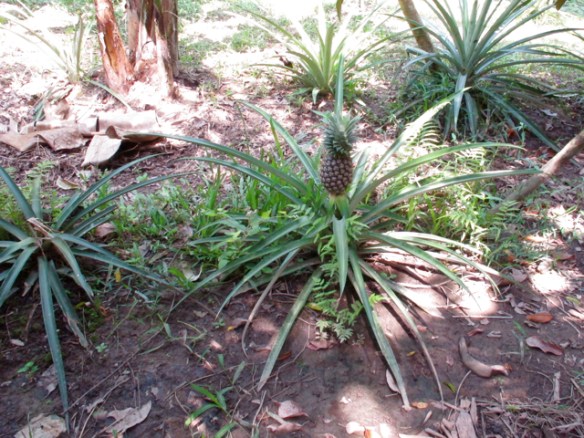
During a floating market tour in Can Tho, we walked through a garden with a pineapple tree (plant?) growing near a coconut palm. Our fellow tourists from Germany expressed surprise that pineapples grow out of the ground. That’s it, I thought. Pineapples (dứa) grow up from the ground and have an up inflection, while coconuts (dừa) fall down from the tree and have a down inflection.
Never mind that I could just use another word for pineapple (thơm) that sounds nothing like coconut. I was pretty proud of myself for that one. But creating mnemonics for every Vietnamese vocabulary word? Fat chance. So it’s back to my little book, hoping that writing things down will help me recognize and remember new words. I need to sort and catalog them into different mental bins for the different tones. Learning to read, write and speak a word all at the same time seems like a tall order, but I’m realizing I can’t really do one without the others. The only way I’ll be able to navigate this language is knowing which way the tones go.

Writing it down….Photo by Bao Quan Nguyen.





 Erin Loury